
15th December, 2024
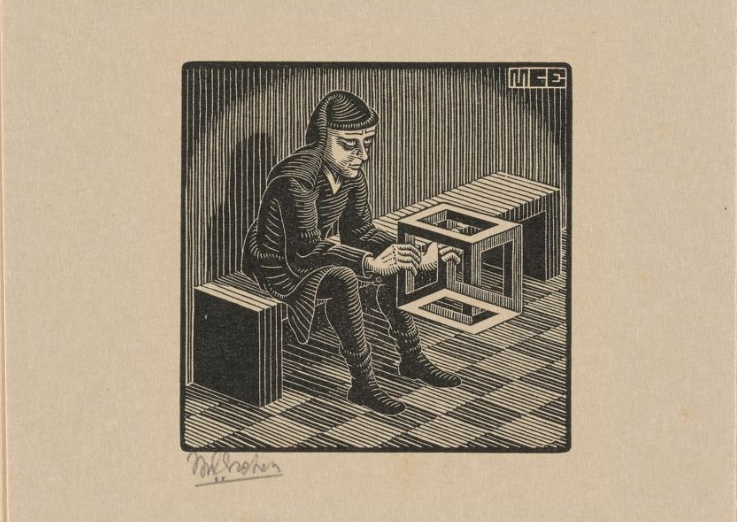
Man with cuboid, wood engraving (1958) by M.C. Escher
How does adversity result in psychopathology?
Childhood maltreatment is associated with a wide range of later mental health problems, including depression, anxiety, substance use, and post-traumatic stress. That association is now well established. For clinicians, however, the more useful question comes afterwards:
How does an adverse experience actually become psychopathology?
Understanding that pathway matters because mechanisms offer potential intervention points. We may not be able to undo what happened to a child, but if maltreatment affects later mental health through sleep, stress regulation, social functioning, pain processing, or another modifiable pathway, perhaps we can interrupt part of that process. This is one of the major promises of mechanism research.
Sleep provides a good example. In our research among adolescents at high risk of emotional and behavioural problems, childhood maltreatment was associated with poorer multidimensional sleep health. Rather than looking only at sleep duration, we combined several aspects of everyday sleep, including regularity, satisfaction, alertness, timing, efficiency, and duration, using both subjective and objective measurements. Maltreatment was associated with poorer sleep across this broader picture.
That finding is interesting clinically because sleep is potentially modifiable. If maltreatment contributes to disrupted sleep, and disrupted sleep subsequently contributes to depression or emotional dysregulation, improving sleep might reduce some of the downstream consequences of adversity.
We have also examined pain processing. Here, the result was perhaps less intuitive: childhood maltreatment was associated with lower pain sensitivity, suggesting possible habituation to painful stimuli rather than the heightened sensitivity we might initially expect. Such findings raise broader questions about whether repeated adverse experiences alter the way children learn to perceive and respond to bodily or emotional threat.
Finding that maltreatment is associated with sleep or pain sensitivity, however, is only the beginning. It does not establish that either explains the later development of psychopathology. This is where mechanism research becomes methodologically difficult.
A common approach is to start with an association between maltreatment and later depression and then add a suspected mechanism, say sleep, to a regression model. If the association between maltreatment and depression becomes smaller after adjusting for sleep, researchers may conclude that sleep “explains” part of the effect.
That sounds reasonable, but it can be misleading.
If sleep really lies on the pathway from maltreatment to depression, then adjusting for sleep means statistically removing part of the very process we are trying to understand. The remaining maltreatment coefficient answers a different question: what is the association with depression apart from the pathway through sleep?
That can sometimes be useful, but simply comparing the coefficient before and after adjustment is not a strong test of mediation. It becomes particularly problematic when the mediator is itself influenced by other factors that also affect mental health, or when those factors have themselves been affected by maltreatment.
In real clinical development, pathways rarely look like a simple chain of three boxes. A maltreated adolescent may sleep poorly, become more emotionally dysregulated, withdraw socially, perform worse at school, start using substances, and experience further adversity. Many of these processes influence each other. Mechanism research therefore needs to ask a more precise question than: Does the maltreatment coefficient become smaller when we adjust for something?
One increasingly useful way to think about mediation is more clinically intuitive:
Imagine two otherwise comparable groups of maltreated children. In the first group, sleep develops as it normally does following maltreatment. In the second, we could somehow give those children the same distribution of sleep health that we observe among children who were not maltreated.
We cannot literally perform that experiment. But modern mediation methods can try to estimate what would happen under such a hypothetical intervention. The question then becomes:
How much would the mental health disadvantage associated with maltreatment be reduced if we could shift this particular mechanism towards the level seen in children without maltreatment?
If improving sleep to that degree would barely change later depression, then sleep may be an interesting consequence of maltreatment but a relatively weak intervention target for preventing psychopathology. If the predicted reduction is substantial, sleep becomes much more interesting therapeutically.
The same logic could be applied to emotion regulation, social support, stress physiology, pain processing, or other candidate mechanisms.
Importantly, these analyses still do not magically prove causality. We need to know that the adversity preceded the proposed mechanism and that the mechanism preceded the outcome. We also need sufficiently rich information about factors that could influence both the mediator and mental health.
The framing itself is an improvement - rather than asking whether a variable “explains away” the association between trauma and illness, we ask what might happen if we could actually change that variable. A mechanism becomes clinically interesting when it points towards something we can do.